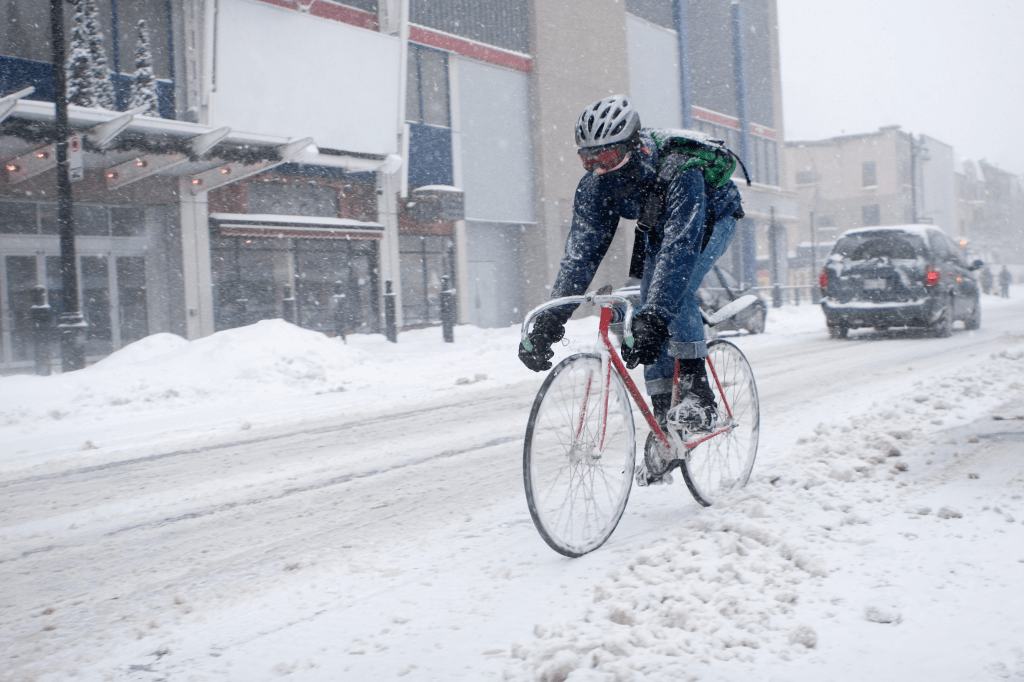
A couple of evenings ago I was enjoying a drink with some colleagues, and a core existential question arose: why is it so much harder to cycle when its -15C than when it’s a balmy +10 or +20C?
This question is existential, because it dominates the existence of winter cyclists in Montreal.
As I toiled home on my bike in -18C temperatures I decided to take a deep dive into cycling nerdery. This is what I came up with: by no means the rigorous final word, but the beginnings of an explanation.
Tire rolling resistance increases in the cold
Tire rolling resistance drops 17.6% as temperature rises from 20C to 40C. I’m sure non-linearities occur as temperatures gets colder, but assuming it drops a further 17.6% for every 20C, at -15C bike tires would produce 1-(1-0.176)2= 32% more resistance than at +25C.
In practice, rolling resistance of a good commuter tire is about 25W per tire.
So, if tires absorb 50W (2 x 25W) at +25C (which is the test temperature), then they will absorb 50W * 1.32 = 66W at -15C.
This does not seem big, but it is noticeable because most of us produce about 100W or so when cycling at a commuter pace (this would be cruising pace: we produce more power when we accelerate or go up hills, but typically we do not sustain it).
So, whereas we have 50W available to overcome wind resistance, potholes and slush at +25C, we only have 34W available at -15C (and, of course, there is no slush at +25C!).
We generate less power as skin and muscle temperature drops
But it gets worse… because power output drops as it gets colder.
So, if we produce 100W on a warm day, we may just be producing 85W at -15C … just having cold skin temperature is enough for power and endurance to drop.
So, that 34W surplus available at -15C (after rolling resistance is factored in) now drops to maybe just 19W !
Extra clothing absorbs energy and increases wind resistance
Even though nothing keeps one warm on a bike at -15C, it definitely helps to have thicker trouser, coat etc… These impede movement, increase energy use (i.e. the power needed) and increase wind resistance.
Even if we cycle sedately, wind resistance is a big factor when we head into the wind! They could conservatively shave off another 5W, leaving us with a 14 W surplus.
Air viscosity increases in the cold
Those meagre 14W that we have left (assuming we are trying to cycle at summer speeds) must overcome air resistance. Unfortunately, the viscosity of air increases as temperatures go down: a recent study indicates that there is a 15% increase in drag as one moves from +25C to -15C.
So how can anyone propel a bike in winter?
At this point, we have probably ground to a despairing halt. Many cyclists will have sensibly got off their bikes and taken a bus: but some persevere. How do we manage, with virtually no power left to move forward?
Well… all these numbers are for a given speed. For example, tire rolling resistance is measured at 28 km/h, faster than normal urban riding… so the numbers above are indicative, though the reasoning is sound.
The reason we can still cycle in the intense cold, despite the considerable extra power needed to cycle for a given summer pace, is that, perforce, we cycle more slowly.
As we slow down rolling resistance lessens (tires dissipate less energy because there are fewer cycles of compression/decompression per unit of time) and wind resistance lessens (it roughly decreases with the square of speed) : this means that far more of the 85W that we have available at -15C (assuming 100W at +25C) are available for propulsion at lower speeds
Unfortunately, by force of habit we often (try to) revert to ‘normal’ +25C speeds, which are far tougher to reach at -15C.
The only way to cycle through Montreal winters: slow down!
To enjoy winter cycling in Montreal, we must adapt – not only to the bitter cold and slippery conditions, but to the fact that (even on the pristine, superbly maintained, cycle lanes that Mayor Ferrada will provide once her audit is complete) we simply cannot cycle as fast as in summer.
The secret to winter cycling – irrespective of ice and snow, which also force us to slow down by absorbing more of our energy – is to cycle slowly: but that means we spend longer in the cold, and the whole thing feels harder and more of a slog!
***
Note added after first publication
Some readers have suggested, on LinkedIn, other reasons why winter cycling is harder. Many thanks.
1- The grease in wheel hubs and bottom bracket gets more viscous, and the bike chain gets dirty (and rusty) quickly – probably faster than one can clean it. It is simply harder to overcome the increased resistance of the bike mechansim itself. In fact, one of my drinking partners also suggested this. I agree!
2- Increased exhaustion may come from the need for more intense concentration as one deals with ice, changing snow and slush, skids, etc… This mental stress is certainly part of winter cycling, and must add to the feeling (and the reality) of tiredness.
3- The time and effort it takes to simply get ready: ensuring the correct clothing, a sufficiently protected lunch-box (so that it does not freeze), getting layered-up, sorting out frozen locks (maybe with frozen fingers)… all this before one is even on the bike. Not to mention the reverse hassle upon arrival! How could I have overlooked this? I guess I was nerding out on the technical stuff.
 Richard Shearmur