Algorithms: or how to make responsibility disappear
I am reading a fascinating book (Revolutionary Mathematics, by Justin Joque, Verso, 2022) in which he develops the idea that the current takeover of many everyday processes by algorithms (of which he explains the logic and maths – which I find fascinating!) is a form of objectification in the Marxian sense, i.e. a process by which relationships, connections and responsibilities are transferred to objects (under Marx these were machines and factory processes; for us it is algorithms and computer processes) thereby removing them from critique or engagement….
One key consequence of this is that, if there is a problem or complaint, it is no one’s responsibility: it is simply what the factory/algorithmic process “does”. In other words, issues of real importance and relevance to people (often those who do not quite fit algorithmic expectations) become objectified.
‘Issues’, we are led to believe, cannot reflect problems with algorithms: after all, these are ‘neutral’ and ‘logical’ objects and processes, above the messiness of subjectivity and belief.
Therefore, if there is an issue, it must be with people (who cannot attain the “neutrality” and “logic” of algorithms). Since people are at fault, they should simply accept algorithmic ‘decisions’ and processes, whatever they happen to be.
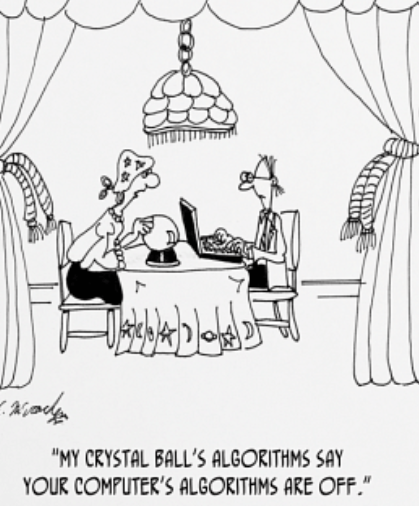
The politics of objectification
Joque, of course, argues that such objectification is political: for him, the issue is not objectification itself (after all, machines and computer algorithms can be very useful) but the hidden politics of objectification. And there, the maths behind algorithms become crucial, because a lot of them are based upon Bayesian statistics, which, like all stats (but more explicitly than other types of stats) are grounded in belief, choice and subjectivity.
Yet, it is easy for politics and interests to hide behind stats, which are portrayed as ‘objective’ and ‘logical’, just like mechanical processes were in Marx’s day (and still are).
This means that even if one delves deep inside algorithms (which is almost impossible given their black-box nature : even their makers hardly understand the connection between input and output) one will eventually be faced with a wall of ‘objective’ and ‘logical’ statistical reasoning, a wall which Joque deconstructs.
Joque is not alone: statistics rest upon beliefs and assumptions
It would be easy, for those who want to disagree, to dismiss Joque as a raging Marxist.
First, this would be unfair to his thougtful and instructive book.
Second, it would also require ignoring authorities in statistics such as David Spiegelhalter, John Ioannides, the American Statistical Association and many others who, in diverse but related ways, all highlight both the incredible usefulness of statistics but also their ultimately subjective nature.
All statistics are founded on assumptions and beliefs about what probability is, what should be measured and what should be reported.
This does not invalidate statistical analyses, but underscores their similarity with qualitative methods where assumptions and beliefs are recognized, and explicitly assessed when methodologies are discussed and results interpreted.
Statistical analysts – as Joque, Ioannides, Spiegelhalter and others argue – should recognize the beliefs, values and choices that underpin their analyses, and grapple with them instead of holding on to a façade of rigorous objectivity.
Why this post? Today’s minor run-in with an algorithmic process
Anyway, yesterday and today I was being manipulated by (or rather, was bending over backwards for) an incompetently programmed on-line process.
I complied – I had no choice: I was the error, not the process.
However, in light of the above, it behooves me to put up some, admittedly Quixotic, resistance!
I therefore cast an email into the void, in which I express my frustration with the souless algorithm that, despite being neutral and innocent (how can logic be biased? how can a process be guilty?), very concretely wasted my human time and energy.
And so 2026 begins….
[Addendum: 3rd January. In response to the email below, which I thought was being cast into the void, I received a nice response from a person, with whom I had a cordial and constructive exchange. We agreed that, next time, unless CATS has been updated, I would be able to correct proofs by annotating a PDF document. I would like to thank the Taylor & Francis employee for the exchange. I am grateful for this human interaction. Being listened to, even if there is no immediate solution, makes a huge difference (and knowng it is a person, not AI, also makes a huge difference!]
***
Appendix: Quixotic resistance to a computer-governed workflow
From: Richard Shearmur, Prof <richard.shearmur [xx] mcgill.ca>
Sent: January 2, 2026 11:49 AM
To: UJUA-production@journals.taylorandfrancis.com <UJUA-production@journals.taylorandfrancis.com>
Subject: ReSubmitted Corrections for Manuscript ID: xxxxx : CATS is a terrible system
Dear Taylor & Francis,
I have just had a terrible experience with CATS, which is the worst proofing system I have yet come across.
1- No password was sent for the log on. When I sat down to work on the proofs, I was therefore unable to access them.
2- There appears to be no automatic system to send a password to my email address. After I asked for a password via email, and one was sent, but only the next day.
3- I was unable to update my password from the temporary one provided: I scrupulously followed the instructions for a valid password, but was unable to alter the temporary one provided. I was therefore unsure whether I could log back into the system, and was forced to perform the proof reading without a pause, hoping for no connection issues.
4- I TWICE lost all my responses and corrections, by accidentally clicking on live links in the proofs. I immediately returned to the proof site, but all corrections were lost.
5- There is no ‘Save’ button. There is only a ‘Save and continue later’ button: but with major uncertainty over whether I could log back in, this button was useless. I was not about to risk leaving the proofing page and being locked out.
All told, CATS is a terrible system that needs to be either scrapped (in favour of simple annotated PDFs) or seriously overhauled. I have wasted at least three hours of my time dealing with an archaic system that is a step back from simple annotated PDF proofs.
Yours, after working five hours on a two-hour proofing job,
Professor/Professeur Richard Shearmur, OUQ.
 Richard Shearmur