What is Masdar City?
Masdar City is a well-hyped suburban development close to Abu-Dhabi airport, about 30 minutes from the (rather amorphous) centre of the metropolitan area.
It is hyped as :
“A ground-breaking sustainable urban community and a world-class business free zone and technology hub, with innovation in [its] DNA. Driven by the UAE’s commitment to sustainability, Masdar City is driving global solutions to climate change and helping create cities of the future.” (https://masdarcity.ae/ )
Started in 2006, with the first phase (the one I visited) completed in about 2012, Masdar City epitomises the idea of an ‘eco-city’ (or rather, an eco-neighbourhood) designed to promote sustainable economic growth and social development. It has not taken off as hoped, and by 2023 only 15 000 live there with further development stages postponed.
Some informed opinions on Masdar City
The concept of eco-city has been studied, and critiqued. Federico Cugurullo, leaning on his case study of Masdar City, concludes that:
“the foundations of the eco-city are strongly grounded in economic concerns […T]he social and environmental aspects form only a layer aiming to hide the real nature of the phenomenon.”
Cugurullo, 2013
Much depends on what one is looking for in a city or neighbourhood. From a purely engineering and technological perspective, some recent scholarship is effusive. Pandita et al (2024), state that:
“Masdar City, a trailblazing example in the United Arab Emirates, stands out as an impressive case study. The concept of Masdar City, with its distinct blend of technological expertise and commitment to sustainability, opens the door to a more promising and sustainable future for metropolitan areas.”
Pandita et al (2024)
Somewhere between the economic realism of Cugurullo and the techo-optimism of Pandita et (al), stands Kashef (2024) :
“Masdar City exemplifies an incremental model of sustainable urbanism, grounded in ecological design principles and framed by techno-optimism. Its implementation, while notable for pioneering renewable energy integration and sustainable mobility, remains constrained by elite-oriented programming, privatized governance, and limited scalability. It reflects a hybrid logic that merges traditional spatial morphology with technocratic experimentation, yet remains largely insular and detached from broader societal transformation”
Kashef, 2024
My own impressions
My first impression is that Masdar City is suprisingly located: it is next to the airport, but in a rather empty area distant from other economic and social activities in Abu-Dhabi. To get there requires a 30 minute drive along wide and dusty highways, through a rather desicated suburban landscape.

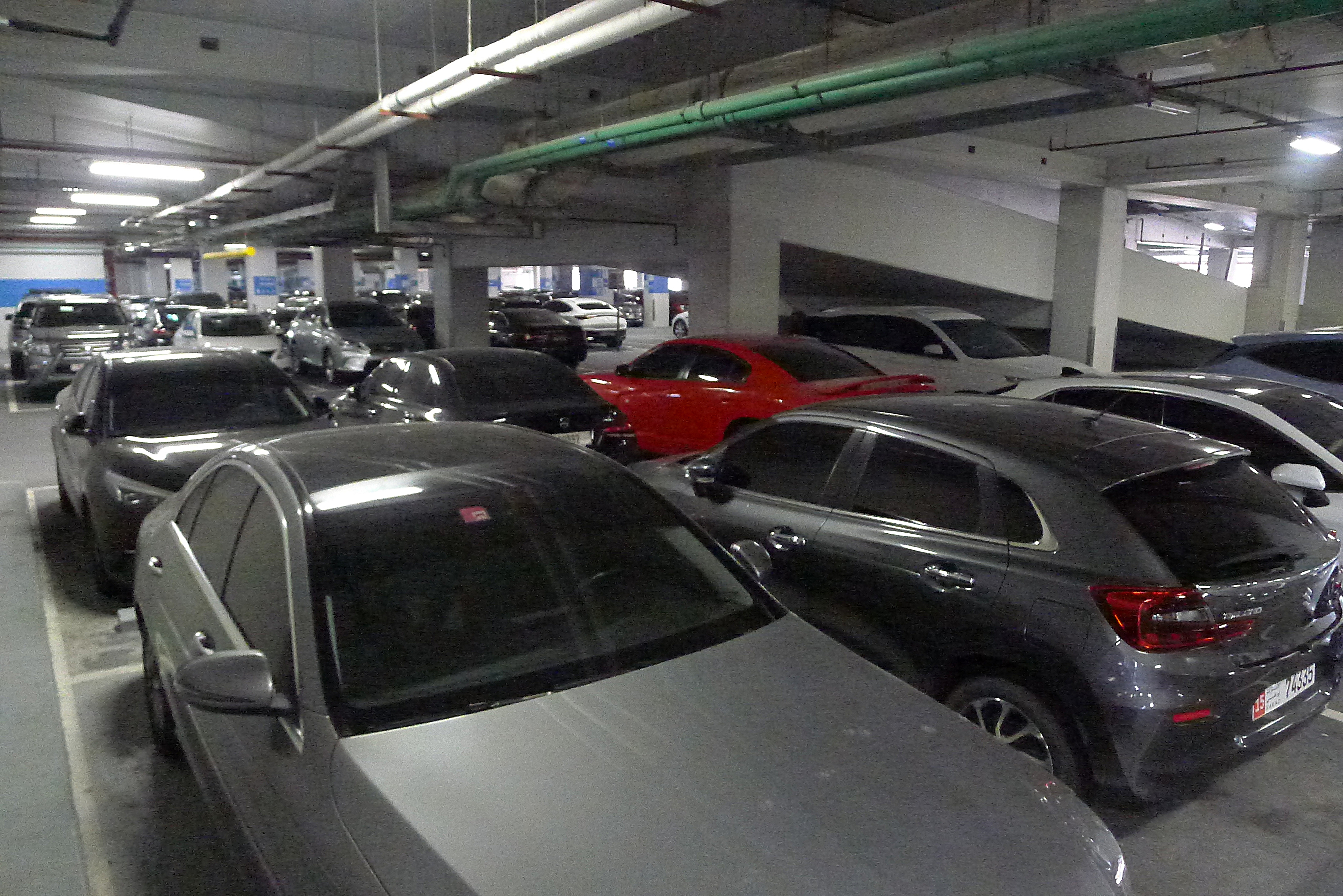
The neighbourhood – or at least the part of it that has been built – sits atop a podium. Beneath the podium is a large car-park (housing all the vehicles necessary for people to get there), services for buildings atop the podium, and a rather clunky self-driving pod system.

The pods are not really self-driving, though they are indeed driverless. They run along a closed underground circuit, guided by embedded magnets set every two meters: as such, they are more like a mini-tramway.
There is a visitor centre at Masdar city, worth mentioning because it showcases a 2012 (?) version of AI, with touchscreens that only half work and an interface that feels dated despite the neon lights and shiny furniture.
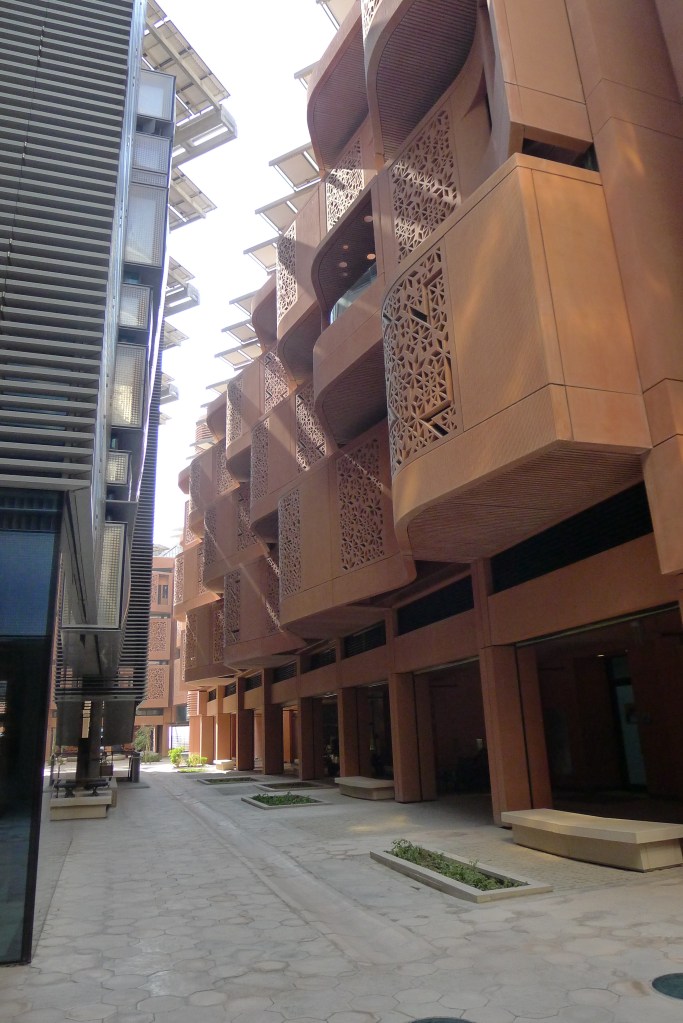
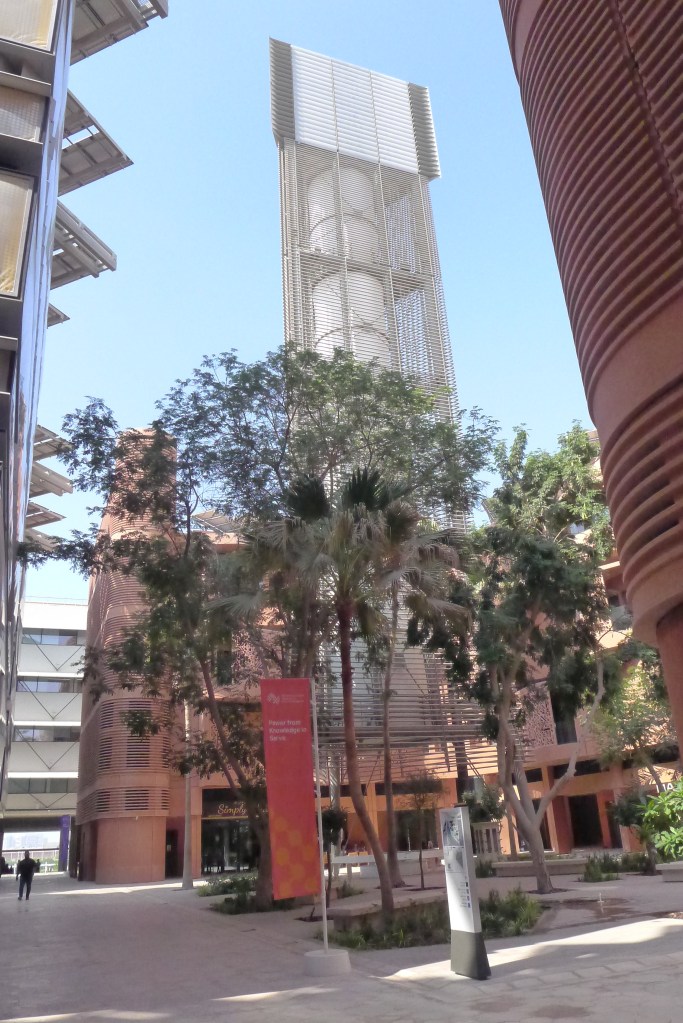
On the surface – i.e. atop the podium – Masdar City is pleasant. It indeed “reflects a hybrid logic that merges traditional spatial morphology with technocratic experimentation” (Khalef, 2024). The narrow shaded streets and small squares create a cool environment that maximizes the gentle breeze. Of particular interest is the passive ventilation system installed in a square, a hollow tower (inspired by centuries-old middle-eastern architecture) that allows convective forces to activate airflow.
Not everything works. As soon as Masdar’s urban design departs from narrow streets, shade, and cooling, it ceases to work. Even in November – a cool part of the year – the wide-open park spaces are hot and uninviting.
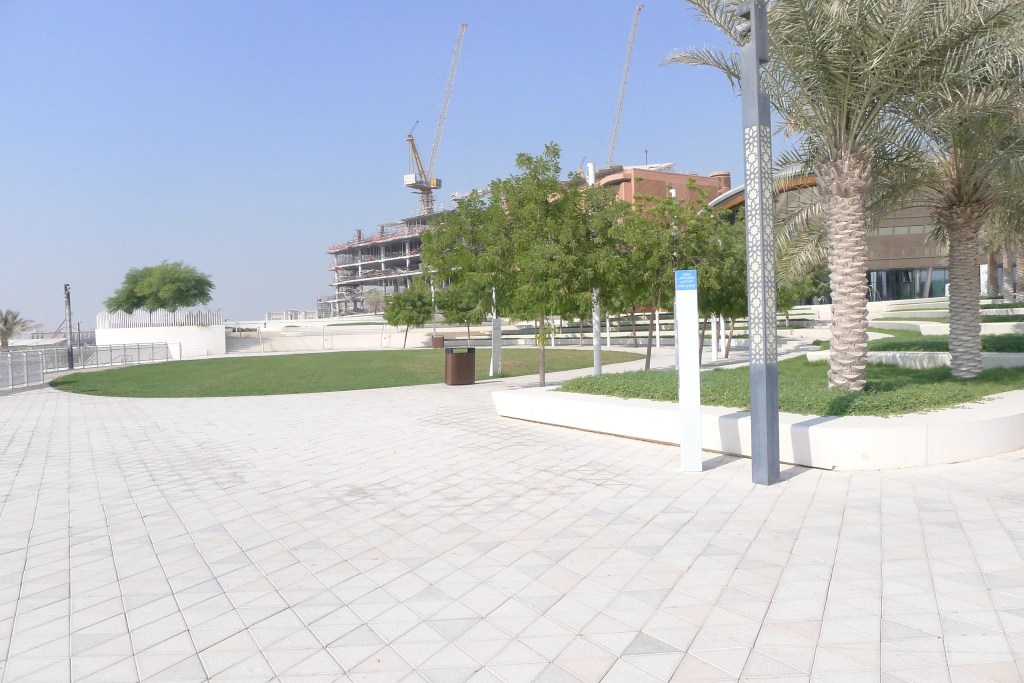
Finally, the city seems empty. Despite Masdar City’s many design qualities, in the middle of a working day, when most business districts are lively, it feels like a ghost town.

Beyond green technology: location, community and governance
I only made a short visit to Masdar City. To obtain a more informed perspective, I invite you to read some of the in-depth papers that have been written on it.
Still, my brief visit leads me to the following tentative observations:
- A sustainable neighbourhood can only be sustainable if it does not require a 30 minute drive to get there. It either needs to be connected to the wider city by a comprehensive public transport network, or it needs to be built within walking distance of where people and businesses are already located.
- Smart cities should NOT incorporate state-of-the-art technology. By definition, state-of-the-art technology this year will be out-of-date the next. The most impressive piece of technology I saw was an adaptation of millenia-old passive cooling techniques. Solar cells, a technology that is now 50 years old, and therefore tried-and-tested, also make a lot of sense. But clunky self-driving pods and arthritic AI, state-of-the-art in 2012, are now dated and inefficient.
- Stick to the vernacular, and experiment tentatively. Masdar City works best where it is inspired by, and adapts (using new materials, designs and ideas), middle-eastern and North-African urban design traditions. This makes sense: over millenia these traditions have evolved to make places liveable in hot and sandy regions. As soon as traditions are imported from elsewhere (such as green spaces and open parks) they need to be ruthlessly evaluated and – more often than not, I suspect – discarded.
- Technology does not make a city (or a neighbourhood) I am not a specialist in green technologies, and am therefore prepared to take Pandita et al (2024) at their word: I will provisionally accept that, from an engineering perspective, the energy, transport and cooling technologies deployed in Masdar City are great. Yet neighbourhoods are not, first and foremost, about technology: they are about density, accessibility and liveability, which in turn revolve around location, community and governance. Masdar City seems to fall short in terms of density and accessibility, reflecting issues connected to its location and to its economic and social communities (which cannot be forced into being, but will maybe evolve).
- Location is a fundamental dimension of neighbourhood (and building) sustainability. However green and up-to-date the technologies deployed, if a neighbourhood (or building) is inaccessible it requires extra time, ressources and energy because it is distant from necessary connections and networks. It will therefore not be particularly sustainable.
 Richard Shearmur