Paris has been re-thought for bikes, pedestrians and scooters
I am currently spending a few days in Paris, where I grew up (well, in its suburbs). Paris has noticeably changed changed since the 70s and 80s: bike lanes and pedestrian streets are now ubiquitous.


I have just wandered from Gare Du Nord to Châtelet, and have dodged more bikes, revelers, and scooters than cars.
Despite this, I have no intention of claiming that Paris is an example for Montreal. Rather, I am struck by how different the two cities are: so much so, it is virtually pointless for Montreal to take Paris as an example (except, maybe, for specific small-scale design ideas).
Why should Montreal forget Paris?
However amazing the transformation of central Paris – and it is central Paris, not its suburbs, that have changed – there are structural reasons why the transformation has been possible. Montreal does not have these structures.
Which structures?
1- A very dense metro network
The Paris metro is extremely dense, with many stops less than 500m apart. The metro (and the buses ) are a viable alternative to cars. This metro system has essentially been in place since the 1920s, and the city has developed around and above it.

2- A dense and frequent regional express service (RER)
In the 1960s France, i.e. Charles-de-Gaulle, decided to build a regional train network that runs directly beneath central Paris. By the end of the 1970s, the RER was functional, and allowed Parisians to get out of Paris to places such as the Forêt de St.Germain, St.Rémy-lès-Chevreuse …. and to the airport!
This system was then extended to Poissy (where I lived at the time, about 25km from Paris) in the early 1990s, to Pontoise, Marne-la-Vallée…
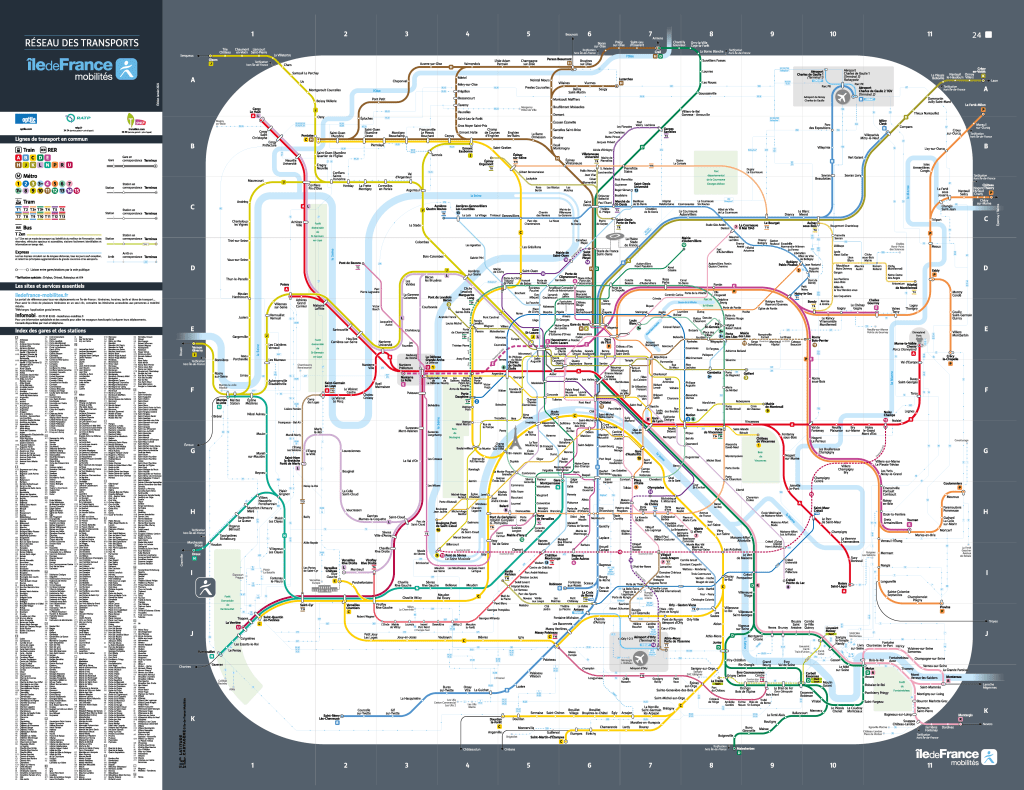
3- A dense and frequent suburban train network
The traditional suburban train network, which has been around since the late 19th century, serves inner and outer suburbs from terminus stations in Paris, allowing Parisans to hop on trains and get out of town (with their bikes if they wish to go on bucolic rides).
4- A viable national train network, including high speed trains
If suburbs do not suffice, it is possible to leave central Paris for vacations throughout France (and Europe) by train.
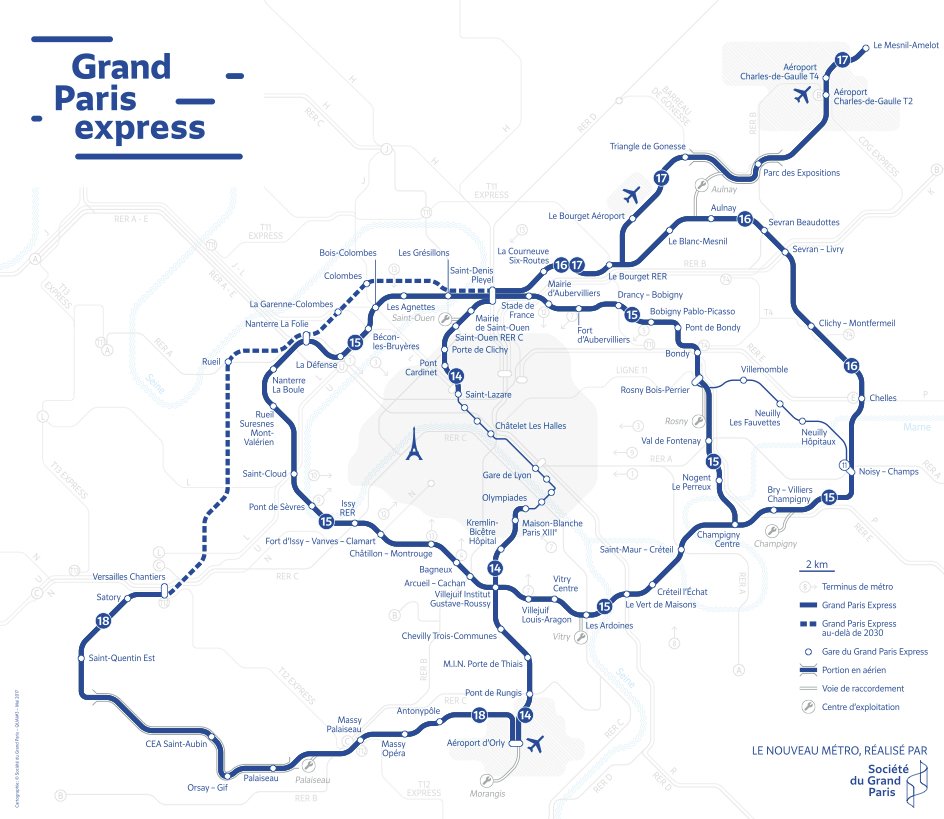
5- The RER, metro and train networks continue to grow
Paris is currently building 200km of new rails to create a ring round the region, about 10-20km away from central Paris. New lines (such as RER E and metro line 14) have been opened (or been extended) fairly recently. Trams have been introduced that follow the inner-ring road (the périphérique).
6- Paris itself is super dense
Paris is, except for circulation space and parks, entirely covered by 6 to 9 story buildings. Most of its close suburbs are as well. This means that it is very dense: this density makes feasible 15 minute neighbourhoods (not cities) : there are sufficient people in most places to allow local businesses to survive based on pedestrian and cycling clientele.

***
So, to sum up. Yes, Paris has undergone a noticeable shift, away from cars and towards cycling and walking, over the last 20 years.
But this is possible because Paris was initially built to the pedestrian scale in earlier centuries, and was retrofitted for cars. The retrofit is now being stripped away.
In practice, pedestrianization, cycling and car reduction are feasible and socially acceptable there because:
- Parisians can easily get around, and out of, Paris by public transport, for work and for leisure, near or far. Unlike in Montreal, being car-less in Paris does NOT confine one to the narrow limits of an inadequate local transport system.
- Suburbanites can easily get into Paris by public transport, and soon will have greatly improved suburb-to-suburb connections. Note, though, that suburbs in the Paris reagion, like in most Global North countries, are car-dependent.
- Paris has sufficient density for most people to be able to walk or cycle somewhere worthwhile (shop, park, friends…) within a few kilometers. It is no surprise that the unfortunately named “15-minute city” was revived by a French planner.
Can Montreal manage this?
Montreal developed – as a city – only a few years before the motorcar, and it truly expanded as cars became common, from the 1920s onwards.
Therefore, Montreal is light-years away from having the density and the local and national public transport systems that underpin the cycling/pedestrian revolution in Paris: it will not become the next Paris (nor the next Strasbourg, Barcelona, Amsterdam or Copenhagen).
That’s fine.
Montreal and its planning community should therefore free themselves from Europe-envy and try to imagine a transport system (i.e. not just a few isolated projects) for a city with lower central density, limited public transport (beyond its modest metro network and REM), and extensive low-density suburbs (some fairly close to its centre).
Cars – hopefully electric – will continue to play a role in Montreal for many years: this does not mean they should dominate all spaces. It means that any approach that begins with the premise that cars can disappear (because, hey, look at Paris and Barcelona!) is bound to fail (if only because neither Paris nor Barcelona – nor Copenhagen nor Amsterdam… – have actually banned cars!).
I know this is a challenge; but it is not by repeatedly “liking” examples from European cities and by suggesting Montreal can easily copy Europe that this will happen.
Montreal is Montreal, and it requires original Montreal solutions.
 Richard Shearmur
One thought on “Bikes and the city : forget Europe-envy and invent a Montreal approach”