Vélo-Québec is a non-profit organization, founded in 1967 to promote the use of bicycles in Québec.
It remains Québec’s primary advocacy group for cyclists and cycling, but it also takes very seriously its role in promoting cycling in a positive way. In this blog I want to emphasize just how good Vélo-Québec is at democratising cycling and cycling events.
Indeed, over and above its lobbying, one of its main impacts is simply organizing accessible events so that people of all ages and abilities can enjoy cycling (and participating in large, non-competitive, events)!
What does Vélo-Québec organize?
Each year, Vélo Québec organizes a variety of cycling tours and holidays. Some of these are guided tours in exotic parts of the world – such as Europe, Japan, the Caribbean.
Others are local to Québec, and easily accessible to all at a modest cost.

I have participated in 4 local events this year:
1) The tour de l’île de nuit. For one evening in late May cyclists take over the centre of Montreal, following a route of about 40km through various neighbourhoods. About 17 000 cyclists participated this year, with people of all ages and all types of bikes.

2) Le défi métropolitan. This is an event organised on open roads, but with support vehicles, water and lunch stops. Within the single event there are multiple possibilities, ranging from routes of about 60km to routes of about 160km – typically there is a core route of about 100km, with the possibility either of taking a short-cut or of adding bits on. About 2800 cyclists participated, which is quite an incredible number.
3) Le Grand Tour. This is a 6 day event, in a Québec region: this year it was in the Outaouais, between Montreal and Ottawa. The tour begins at village A (where cars are parked and luggage loaded onto trucks). On day 1 we cycle from village A to village B, where we set up camp and stay for three nights, doing two rides – loops beginning and ending at B. On day 4 we pack up, load our luggage in a truck, and cycle to village C, where we set up camp for a further two nights, riding one loop, then, on the last day, riding from C to A.
Each day the ride works like the défi métropolitain, with options of varying lengths, and with the possibility of taking a lift if one is too tired. To my knowledge about 700 people did the 6 days, and a further 300 or so joined for three days over the weekend.
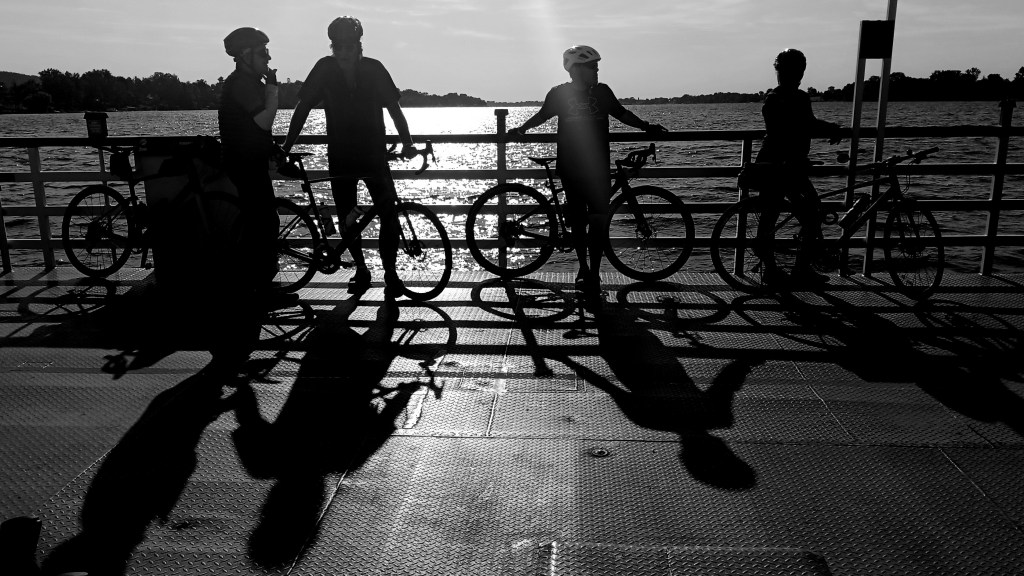
4) Le défi des cantons. The same format as the défi métropolitain, in the Eastern Townships. It took place last Saturday (7th September), starting at Bromont, heading down to Frelighsburg, along the lines to Philipsburg, up North to Ange-Gardien, then back across to Bromont. A stunning ride on a beautiful day. I guess that, again, about 2000 to 3000 cyclists took part.
Non-competitive and open to all
There is a certain genius to how these events are organised.
Non-competitive: They are NOT races. Start times are basically ‘when you want, between 7.00am and 10.00am: many people come as groups, but some, like me, show up alone just to enjoy cycling with others. There is no restriction on type of bicycle: there are commuter bikes, electric bikes, tandems, high-end road bikes…. and people of all ages, shapes and sizes.
Accessible and open to all ages, abilities and fitness: Given that there is a choice of distances, it is quite feasible for a hardened cyclist who wishes to ride flat-out for 140km to accompany their grandfather who wishes to ride 50km on an electric tricycle. They can start off together, and meet at the bar – because yes, beer is served at the arrival location – when both have completed their course.
I realise that not everyone can ride a bicycle, so there exists an inherent restriction: but anyone who can balance on two or three wheels – irrespective of bicycle type, body shape or age (including blind people on tandems) – seems to participate.
Well organized: Finally, whether this year or in previous years, the organization is seamless: friendly, efficient, on schedule – with decently placed water and food halts and beautifully chosen courses. I still feel the rush of the Eastern townships, even though the ride was three days ago!
So hats off to Vélo Québec
It is important to emphasize just how good Vélo-Québec is at democratising cycling and cycling events. Over and above its lobbying, one of its main impacts is simply organizing accessible mass events so that people of all ages and abilities can actually enjoy cycling, and enjoy cycling together!
They have developed an impressive logistical expertise in organizing such cycling events, and I, for one, feel lucky to benefit from it!
 Richard Shearmur