Commuting to work is fun, energising and fast.
But is it feasible to cycle to a work meeting and look professional and smart (enough) on arrival? The short answer is “yes” (most of the time).
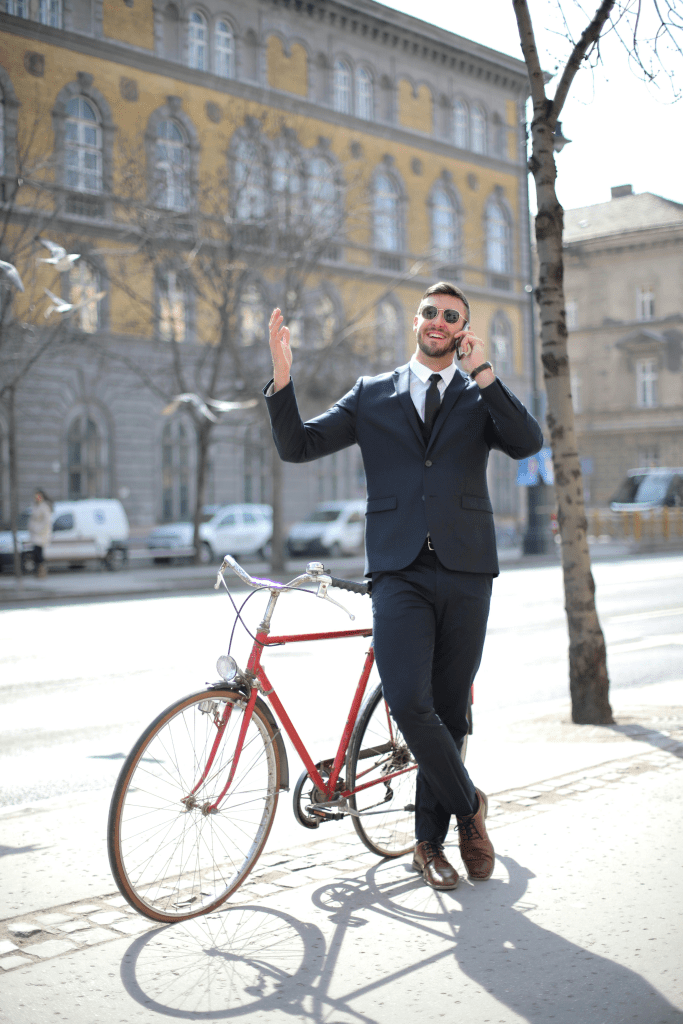
From my 20 years’ or so bike commuting experience, three key factors affect the feasibility of looking presentable at a work meeting after cycling there:
- level of dishevellment (i.e. disordered clothes; clothing not adequate for work; hair…)
- sweat levels (i.e. water from one’s internal cooling system)
- wetness (i.e. water from external factors such as rain)
Dishevellment
It is impossible – unless the ride is very short – to arrive looking 100% immaculate, with perfectly creased trousers, combed hair, straight bow-tie and starched shirt. A certain amount of sophisticated and tasteful sartorial dishevellment is inevitable.
However, it is possible to find stylish trousers (designed for cycling), light jackets (designed for cycling, but not recognisably bike-related), presentable shirts (designed for exercise, but looking professional) and so on.
Golfers look presentable whilst golfing – cyclists can look presentable whilst cycling.
My go-to supplier for jackets and trousers has been Swrve, but this small firm is unfortunately closing, so, in due course, I will be looking into alternatives such as Duer and Vulpine.
Finally, make sure your bike has mudguards: it goes without saying that, however stylish your attire, it won’t look good with a streak of mud up the back.
In a nutshell: it is possible to find excellent clothing, that works well in formal settings, and that is adapted to cycling. It is designed to be worn on a bike, stretches in the right places, is tight in the right places, dries relatively fast, and enables one to arrive shevelled at meetings.
Sweat
This is a perennial problem, a real one, but can mostly be dealt with.

1- Slow down
My first piece of advice is to cycle slowly. A 75kg cyclist moving at 20km/h on flat ground, in an upright position, on an averagely maintained 13kg bike, is estimated to require 76 watts of power. The identical cyclist moving at 30 km/h requires 197 watts, expending over twice the energy per unit of time, therefore generating more heat and sweat. Here is the wattage calculator I used.
For a 6.5 km urban commute, assuming one 1 minute stop per km, 100m of acceleration after each stop, and 100m deceleration before each stop, commute time will be 22.1 minutes for the faster cyclist and 29.9 for the slower one.
Those 7-8 minutes can make all the difference in terms of sweat, and will certainly allow for faster cool-down and less puffing on arrival.
2- Pack a dry shirt
My second piece of advice is to pack a dry shirt.
Where can one change shirts, I hear you ask? Typically I go to the bathroom and change there, not in a cubicle (which can lead to disasters involving phones, wallets and lavatories…), just in the bathroom area.
3- Dress as lightly as feasible, and ensure airflow
My third piece of advice is to dress lightly and ensure airflow around your body, even when it is cold.
You will be amazed at how fast you warm up, even when it is -15C outside. It takes a bit of experience to get the clothing right, but a good outer shell with generous zips that allow air in (when open) and keep it out (when closed), is very useful.
If the weather is hot, cycle in a T-shirt, keeping your work shirt dry in a bag.
4- Don’t wear a backpack
DON’T use a backpack – they are veritable sweat factories.
Use panniers – there are some very good ones, similar to normal computer bags (but with more capacity), that easily hook on and off luggage racks.

The model of bag I have used for about 8 years now. Arkel builds excellent bags (in Sherbrooke, Qc). Photo: https://arkel.ca/collections/commuter/products/signature-h-urban-pannier
5- Allow about five minutes to recombobulate before meeting begins
Just as drivers allow time to find parking and deal with roadworks, just as public transport users allow time for missed connections and mysterious stoppages, so cyclists must allow time to change shirts, comb hair, and generally recompose themselves before entering a meeting.
Cycling is fast and predictable, but this does not mean that transport time can be reduced solely to time spent moving on the bike!
6- What about showers?
Frankly, showers are time consuming, unavailable (at least at McGill), and uncessary if you have started the day clean (i.e. showered before leaving home), are using clean clothes, and can slip on a clean shirt after cycling.
Slow cycling and light clothing also help in this respect, since, as mentioned above, these reduce sweat at source. Avoiding synthetic materials next to your skins also helps.
Rain
It is very difficult to look presentable after cycling through a downpour.
Unless you have packed dry shoes, trousers, shirt, socks and underwear, you will be wet, and your colleagues or clients will notice!
Despite considerable investment, I have not yet found a cycling jacket that keeps me adequately dry (certainly not after a few months’ use, however much I try to regenerate the water proofing). I have not experimented extensively, since these jackets are very expensive – but my experience has been disappointing.
In any case, there is a trade-off between keeping water out and sweating: good waterproofing is never very breathable. On occasion, when wearing a new (and still waterproof) jacket, I have kept raindrops away only to be thoroughly soaked in sweat.
There are plenty of blogs (e.g. 1, 2, 3, 4) that encourage commutes in the rain, and provide advice … that’s fine, if you can dry-off and change clothes completely at your destination.
My advice if you’re heading to a meeting?
Pack a complete change of clothes, dry shoes, a towel, a large plastic bag for wet stuff, and allow plenty of time to change …. or hop on a bus.

Note: I have absolutely no connection with any of the companies mentioned on this page, other than purchasing their products (except Vulpine). However, for those wondering what I mean by stylish trousers and jackets adapted for cycling, or what I mean by a panier that can pass as a computer bag, specific examples are useful. I have given examples I can vouch for: I have been especially impressed with Swrve and Arkel products…
 Richard Shearmur