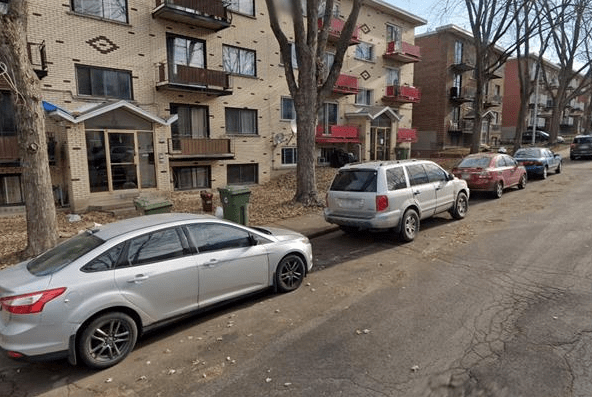
There have been repeated calls in Montreal and elsewhere to phase out on-road parking [addendum : further to the first version of this post, I should specify that CRE-M is advocating that all users pay for on-road parking, not for ban on-road parking]. Ultimately, the aim is to increase the expense and difficulty of owning a car, thereby encouraging a transition towards active or public transporation and reducing the amount of land devoted to automobiles. These are worthwhile goals.
Why specifically target on-road parking?
- it constitutes a large subsidy to car owners. According to the Conseil régional de l’environnement de Montréal (CRE-Montréal) it costs about $1275 per year to maintain each space. Similar arguments are put foward by researchers such as Donald Shoup.
- this is unfair, since about 30% of Montreal households do not own a car.
- if there is less on-road parking, roads could be narrower, and land could be recovered for recreational, environmental or housing needs. [addendum: this is suggested in the article referenced by the hyperlink]
- increasing the difficulty and expense of owning a car will reduce car ownership, and hence greenhouse gas emissions, congestion and pollution.
Is it equitable to phase out on-road parking?
Even though 30% of Montreal households do not own a car, it is not only low-income households who are car-less. Younger households, and those living and working downtown (typically in higher-status professional jobs) are also amongst the car-less.
Who will be most impacted by phasing out free on-road parking? Poorer households who need their car for family or professional reasons.
Who will not be impacted? Wealthier households (who often have off-road or underground parking), suburban households (with space to park a car on their driveway), and households with few time constraints (typically younger and childless). Of course, households without cars (poorer ones, but also younger and city-centre dwelling) will also not be impacted.
Can households function in Montreal without a car?
Households lucky enough to live next to a metro station – who benefit most from subsidies provided to public transport – can often function without a car on a day-to-day basis. Even for them, though, it can be difficult to get a family across town, to transport heavy objects, or to get anywhere that is distant from a metro station.
The reality is that only a few households can function well without a car, and that car ownership greatly increases opportunities and quality of life for poorer households. Yes, it is theoretically possible to get to most places on Montreal island using a combination of metros and buses, but it is so time-consuming that using a car is more realistic given that days only have 24 hours (whatever one’s income level!).
Without on-road parking, many poorer families will find it more expensive, or more difficult, to move around Montreal.
What about car-sharing?
Car-sharing can be useful if one is able to plan ahead, book a car, or accept the risk of not obtaining a car when needed. There is little evidence that car-owners view car-sharing as an alternative to car-ownership. In my experience, car sharing is fine for planned trips (e.g. to IKEA or to a garden centre), but stressful and risky when there are hard time constraints (e.g. driving children to activities: reliably getting a car at a specific time for the outward drive, and again for the pick-up, is almost impossible).
Car-sharing, which is a partial solution to ownership when timing is not of the essence, is not reliable enough.
Without on-road parking, many poorer families will find it difficult to get to specific places at specific times, further limiting their access to jobs, low-cost shops, and leisure.
What about leisure and getting out of town?
Many people, including environmental activists, enjoy hiking, cycling, camping, kayaking, skiing… It is simply impossible to get out of Montreal without a car.
Many years ago there existed trains (e.g. le Petit Train du Nord) which allowed Montrealers to leave the city and spend days in the Laurentian mountains or the Eastern Townships. These trains no longer exist, and the inter-city bus system (not ideal for leisure anyway) is now almost non-existent.
Without access to a car, people are trapped in the city and cannot enjoy leisure activities that most middle-class and wealthy Canadians take for granted.
Car-sharing does not really help, since a car is only needed for the drive out and back. It will remain idle during the break: days in a car-park as the passengers kayak, camp or cycle! For the time-being, car-sharing cannot accommodate this type of use.
Again, efforts to get cars off the roads by denying them parking space will have no effect for suburban or wealthier households (those with off-road parking spaces), but will limit the out-of-town mobility of poorer families and households by putting car ownership out of reach.
To conclude: inequity and the politics of discontent
I am in full support of policies that reduce car usage and the space devoted to them.
But simply phasing out on-road parking [addendum: or simply making it costly] will have many unintended consequences, and will mainly impact lower-income households (maybe not the lowest-income households, but certainly not the wealthiest).
From a political perspective, policies such as phasing out on-road parking [addendum: or making it costly] may lead to backlash: forward-looking city leaders, incrementally shifting Montrealers towards active and public transport, may lose support to more populist and reactionary leaders if environmental policies are introduced without careful consideration.
In order to phase-out on-road parking, it is important to:
- consider how and why Montreal households own cars .
- look at who owns cars (and not simply assume that car ownership is a sign of wealth).
- consider who will not be affected by the policy (e.g. suburbanites? wealthy city-dwellers? down-town professionals?)
- understand the connection between car-ownership and access to jobs and leisure both within and beyond city limits.
In the long term, transition away from individual vehicles (electric and gas) is desirable for all the reasons set out by Donald Shoup and CRE-Montréal.
The problem is how can we transition towards this state without exacerbating inequalities and generating a backlash?
 Richard Shearmur