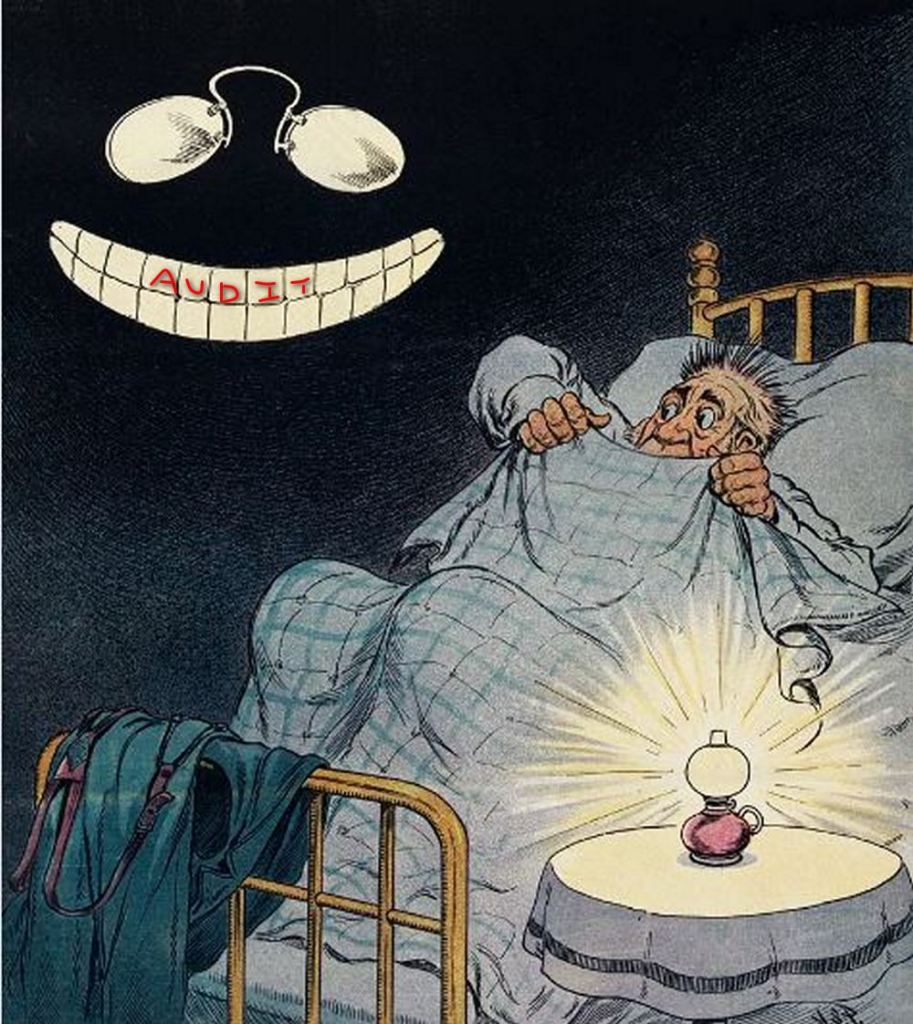
The reimbursement process in at least one Canadian university has become veritably Kafkaesque, a reflection of society-wide issues of over-auditing, accounting platforms and datafication.
More time is spent splitting minute audit hairs (rendered all the more inflexible by virtue of their embeddedness in vast IT systems) than in simply verifying that expenses are justified (which is necessary, but straightfoward in most cases) and promptly reimbursing the person who has spent their own money on the University’s behalf.
Below I set out a super-simple example: but multiply this by each expense report and by each employee who spends money on the university’s behalf, and you can see that the system is dysfunctional. Then extend this to other organizations (I am sure that the my university isn’t the only dysfunctional organization), and you can see how it becomes a society-wide issue.
The case study
I recently travelled on university business. I was informed by my faculty’s finance department that the outward and return trips to my destination are reimbursable expenses.
However, the reimbursement rules state that the “Kilometer allowance or the actual cost of gas not exceeding equivalent rail or economy airfare may be claimed.”
Although I drove 2400km, took a ferry, and spent a night in a hotel to get to St.John’s (at a cost of 0.57$*2400km * $130 (ferry) + $150(hotel and food) = $1648), I put in a claim for an economy one-way flight to St.John’s with two pieces of luggage, i.e. a claim for $630. Justification for this amount (an Air Canada booking for the journey) was included.
Why a one-way ticket? I am unsure of my date of return.
Why two pieces of luggage? I will be based at my destination for 8 months, including winter. I need to bring a few things with me. This was explained in a note appended to my request – all gathered into a single PDF document for ease of use.
First complication:
Although all the information relating to my extended sojourn is in the university’s centralised personnel tracking system, and although my director approved the expense, according to the reimbursement people I need to justify my travel.
Somewhat flumoxed, I sent my letters of invitation (those already in the personnel system) to the reimbursement folk. That seems to have done the trick.
Second complication:
My claim was then further queried because I had not specified my points of departure and of arrival.
But of course I had! All the information provided clearly states that my destination is St.John’s (Newfoundland), and in my email I had specified that I had driven 2400km between Montreal and St.John’s.
Upon further enquiry, it transpires that what was missing was not my origin and destination, but an independent (i.e. Google Maps) certification of the distance. The reimbursement department clearly did not believe that the road distance between Montréal and St.John’s is 2400km, maybe suspecting a far lesser distance which would not justify my claim for $630, but in the process also suspecting my honesty (which they could easily have verified without the slight).
I duly printed out the Google Maps itinerary (discovered that the actual distance along the trans-Canadian Highway is 2542 km). I sent in this hard-to-obtain piece of information, thereby proving the obvious for auditing purposes and restoring my probity in the eyes of the auditing system (which is judgmental, constantly destabilising claimants, making them feel dishonest or mistaken).
Third complication:
I then, after these two queries, received an ominous message from the reimbursement department: “Please provide an available time where we can discuss the requirements by travel as it relates to your report. Once confirm I will send you an invite in Teams”
We arranged a meeting. There is value in talking to a person, because I suddenly understood what had sent by reimbursement request into a tail-spin.
In the centralised IT reimbursement system (which is independent from the centralised IT personnel tracking system), I had ticked the box stating my reimbursement was for an airfare.
However, I should have ticked the box requesting reimbursement for mileage, which I can claim up to the amount of an economy airfaire.
I had ticked the wrong box.
This is unsurprising: I, like most other professors (except those who teach accounting), am unfamiliar with the arcana of audit classifications.
Of course the reimbursement people must have known what had happened; no person was suggesting that the amount of my claim is out of line; no person was suggesting that my travel is not justified for university business… but no reimbursement until I guess which box to tick.
Auditing IT as judge and jury.
How the university is undermining itself
I am paid a decent salary, which works out at about $90.00 per hour gross. This little sequence consumed a good 90 minutes of my time, as well as causing aggravation and distraction from research and conference preparation.
The person working in reimbursements is also paid a decent salary, probably about $35.00 per hour gross or thereabouts. This little sequence probably took an hour of their time, distracting them from other reimbursements, and probably causing them aggravation too.
Not only did this charade cost the University about $170 in direct salaries, it also cost it indirectly in opportunity cost (neither I nor the reimbursemrnt people will work extra hours to compensate for this mess: our time has simply evaporated into box-ticking).
However, there are other more pernicious losses:
- loss of efficiency in professor’s work (distraction, anxiety…);
- loss of efficiency in reimbursement process (a huge amount of time spent aligning reimbursement requests with audit categories, gumming up the whole system; aggravation; anxiety);
- loss of trust in the university. Why would I trust an employer who doesn’t trust me and refuses to reimburse straightfoward expenses unless I jump through multiple hoops (over-and-above filing my expense report – this I understand and am not complaining about)? Why would I advance my employer money when my employer stone-walls reimbursements in such an aggravating way?
- pitting employees against each other. People in the reimbursement department are doing their job, making sure that each box is ticked according to the expectations of auditors and IT programmers. I am trying to do my job, writing, teaching and researching. As a consequence, I begin to resent the reimbursement department (they are the face of inflexible and illogical rules), and they probably begin to resent me (I am the face of flustered, and occasionally angry, users of the reimbursement system).
Unfortunately, Universities are examples of wider processes
Why is this important?
University employees spend their personal money to enable the institution to function. The least the university could do in return is show some respect for this, and proceed diligently and without obfuscation when it comes to reimbursements.
Furthermore, the employer could presume the good faith of claimants: after all, employees must hope their employer acts in good faith – using their money on its behalf – against all evidence (the unforgiving and judgmental IT system is our interface with the employer).
More generally, the audit society (which I have commented upon here and here, and which Michael Power discusses in the light of surveillance capitalism and IT here) is killing off efficiency and goodwill, reducing transactions – even those between long-term employees and their employers – to arcane and distrustful box-ticking exercises.
This inflexible box-ticking is a form of power – wielded by the IT system, the programmers behind it, and the employer who implements it – over uninitiated employees.
It is reminiscent of the Inquisition, which narrowly stipulated the conditions of theological conformity – whilst keeping the definition of heresy secret (and infinitely adjustable).
The tragedy is not that universities are losing goodwill and efficiency, nor that I and the reimbursement department waste our time (farce, not tragedy – at least we are paid!), but that this minor example seems to encapsulate much that is happening in wider society1.
1 Virginia Eubanks, in her book Automating Inequality (2018), describes how these systems have unjust life-altering effects for vulnerable people who are entitled to social security or other support. In the cases she describes, IT systems and audit culture cease to be inefficient farces but become arbiters of life and death.
 Richard Shearmur