Tomorrow is the 1st of July, moving-day in the province of Québec: most apartments are rented on one-year leases, running from 1st July to 30th June, so everyone moves on the same day.
This system has many flaws.
- It is difficult to move (or to find an apartment) at any other time of year, and this will become even more difficult if landlords obtain the right to control sub-leasing.
- Rental vans are unobtainable, and – if you are lucky – excessively over-priced .
- Stairways get blocked, sidewalks are piled high with boxes and discarded furniture, etc…

Source: http://blog.fagstein.com/2008/07/02/the-day-after-moving-day/
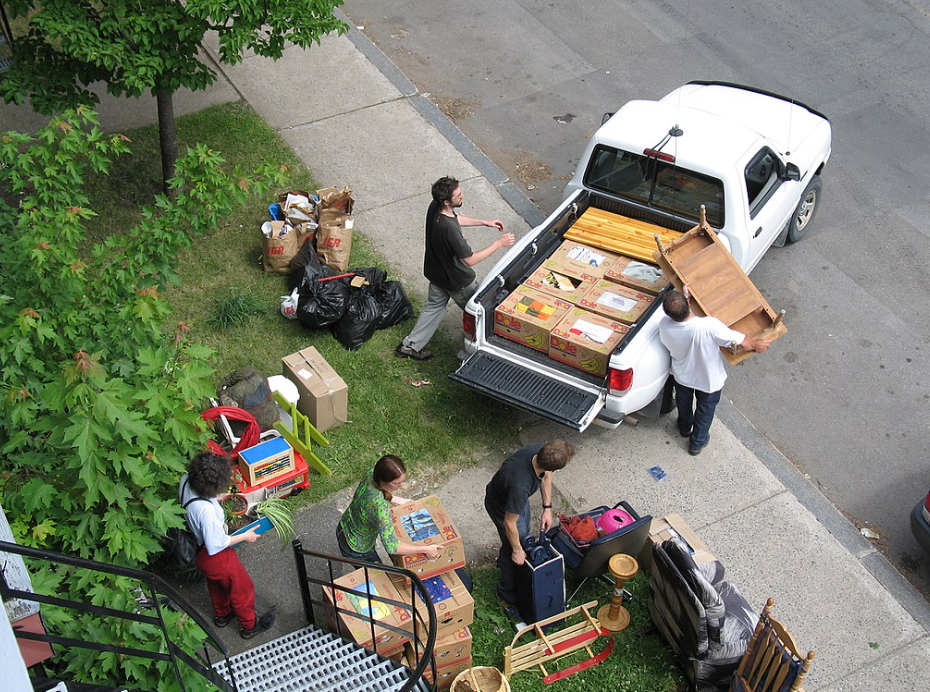
source: https://en.wikipedia.org/wiki/Moving_Day_%28Quebec%29#/media/File:Demenagement_quebec1.jpg
Insufficient housing, rising rents, homelessness and overcrowding
However, the biggest problem is that there are simply not enough houses or apartments in Montreal to house everyone decently. Notwithstanding Prime Minister Legault’s statements, many Quebecers will be homeless, far more than will be apparent tomorrow evening.
Indeed, whilst it is expected that maybe 5 or 600 households will be homeless because they can’t find an affordable place to move to, far more people will be either underhoused, (living in low quality or overcrowded spaces) or paying a large proportion of their income as rent (1)
As rents rise, and as incomes stagnate, the only way to afford an apartment is to crowd more income-earners in or to live without disposable income (or both).
The (good?) politics of housing shortages
Québec’s government is downplaying – or simply ignoring – the housing crisis, with the housing minister (herself a landlord) even being compared to Marie-Antoinette. Despite the outcry, this may be good politics.
Indeed, a house (or apartment) is both shelter and asset.
The housing crisis is a shelter crisis. People cannot find decent homes, and the living conditions of many lower- and middle- income people are deteriorating.
However, the housing crisis is an asset boom. For over 60% of Quebecers (about 38% of Quebecers are renters), the housing crisis leads to an increase in wealth.
From a political perspective, a party that appeals to aspiring middle-classes and property-owners has a vested interest in ensuring real-estate prices remain high. After all, most of their electorate, who are property-owners even if they are not landlords, believe that they benefit from the crisis (which they do in a rather immediate and limited way).
Furthermore, solving the housing crisis will require government intervention (i.e. building social and affordable housing; tenant protections), which implies raising taxes, government spending, and some regulation.
But it has become folk-wisdom that taxes are bad and that government intervention is inefficient.
The long shadow of Thatcher and Reagan
None of this is new: Margaret Thatcher, in the early 1980s, touted the ‘property owning democracy’. Housing shortages are foundational to the neo-liberal politics that have shaped folk-wisdom over the last 40 years, and are “the logical, predictable and expected consequence of our collective decisions in terms of housing”(2).
This folk-wisdom is the hallmark not only Prime Minister Legault’s view of the world, but of much current global politics (under the guise of ‘common-sense‘).
This is why calls for more building, for rent control, for more tenant protection are calls for band-aids. Band-aids are important first-aid solutions (so I am not downplaying their immediate importance), but cannot solve structural or underlying issues.
More building (without a focus on units for lower-income people), rent control (without ensuring building upkeep), tenant protection (without enough affordable apartments), and housing for all (without ensuring decent incomes for all) will not fundamentally solve the crisis – although all can contribute to taking the edge off.
The housing crisis is a symptom of wider problems touching how we understand the role of government, the way wages are set, and the sources and nature of wealth (which encompasses resources, social connections and the natural world as well as human artefacts) .
We are nowhere near addressing these issues.
1 for an up-to-date report on the housing situation in Québec see “Crise du logement : un marché locatif en manque d’encadrement” 29th June 2023, by Julia Posca and Guillaume Hébert
2 The Vivre en Ville report ‘Portes Ouvertes’ (August 2022, by Adam Mongrain, Leila Ghaffari and Gabriel Cote) looks at some of the underlying issues and suggests ways forward, the key being that there is no single solution to the hiousing crisis, which is complex and needs to be tackled on multiple fronts.
 Richard Shearmur
